



Super Tour
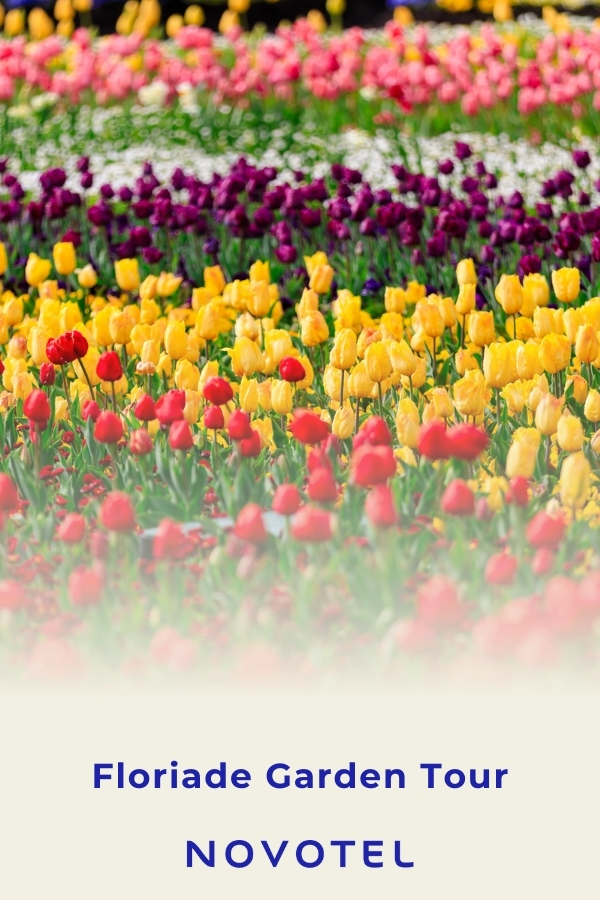
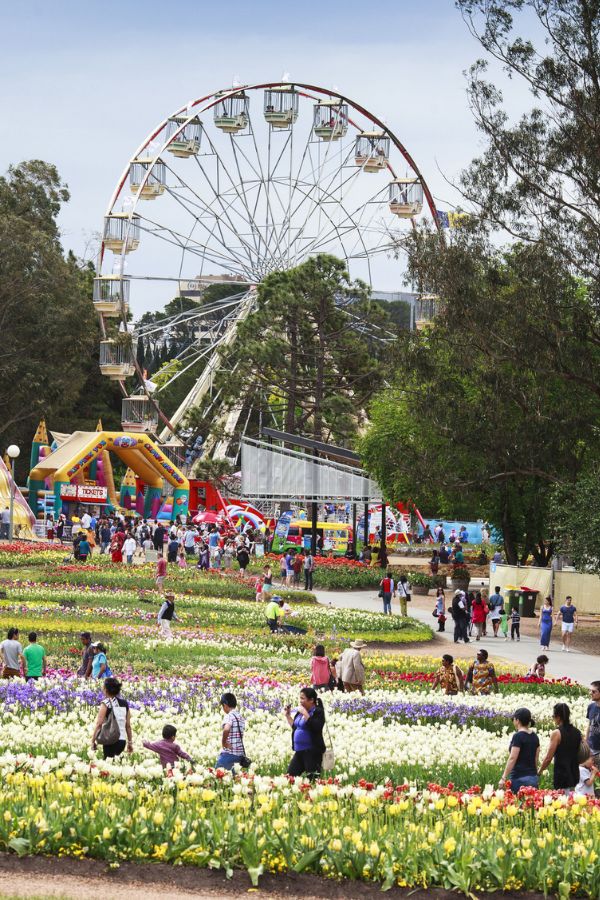
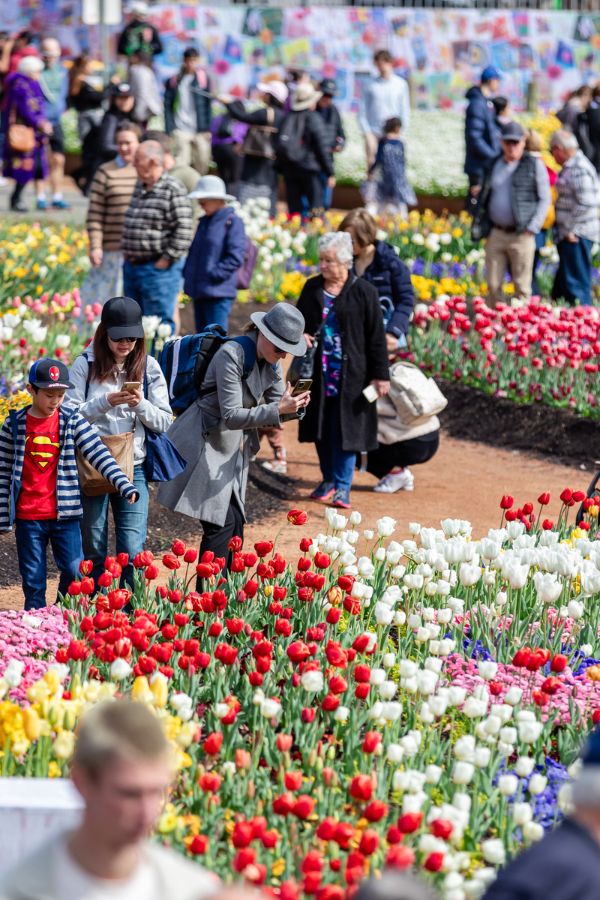
Explore Floriade like never before with this self-guided digital tour. Across twelve garden beds, discover how science and nature come together in vibrant displays inspired by molecules, the human brain, computer circuits, rainbows of light, and even the stars above. Created to celebrate the 50th anniversary of the Australian Honours system, each bed also highlights Australian scientists recognised for their groundbreaking contributions. This tour touches on some fascinating facts, uncovers the stories behind the blooms, and lets you enjoy the festival at your own pace.
moreExplore Floriade like never before with this self-guided digital tour. Across twelve garden beds, discover how science and nature come together in vibrant displays inspired by molecules, the human brain, computer circuits, rainbows of light, and even the stars above. Created to celebrate the 50th anniversary of the Australian Honours system, each bed also highlights Australian scientists recognised for their groundbreaking contributions. This tour touches on some fascinating facts, uncovers the stories behind the blooms, and lets you enjoy the festival at your own pace.
["https://firebasestorage.googleapis.com/v0/b/freeguides-prod.appspot.com/o/assets%2Ftours%2Fxk6I0bEPXk0tbpBBtloj%2FFloriade_Garden_Tour.jpg?alt=media&token=4450136c-3865-4d20-9e45-b02dd8791941","https://firebasestorage.googleapis.com/v0/b/freeguides-prod.appspot.com/o/assets%2Ftours%2Fxk6I0bEPXk0tbpBBtloj%2FFloriade_02.jpg?alt=media&token=e7428990-36e2-45d3-aab0-124dd06bca2d","https://firebasestorage.googleapis.com/v0/b/freeguides-prod.appspot.com/o/assets%2Ftours%2Fxk6I0bEPXk0tbpBBtloj%2FFloriade_01.jpg?alt=media&token=d2e4d1fb-166e-40d8-8d20-becf845af479"]
No items found.
["https://firebasestorage.googleapis.com/v0/b/freeguides-prod.appspot.com/o/assets%2Ftours%2Fxk6I0bEPXk0tbpBBtloj%2FFloriade_Garden_Tour.jpg?alt=media&token=4450136c-3865-4d20-9e45-b02dd8791941","https://firebasestorage.googleapis.com/v0/b/freeguides-prod.appspot.com/o/assets%2Ftours%2Fxk6I0bEPXk0tbpBBtloj%2FFloriade_02.jpg?alt=media&token=e7428990-36e2-45d3-aab0-124dd06bca2d","https://firebasestorage.googleapis.com/v0/b/freeguides-prod.appspot.com/o/assets%2Ftours%2Fxk6I0bEPXk0tbpBBtloj%2FFloriade_01.jpg?alt=media&token=d2e4d1fb-166e-40d8-8d20-becf845af479"]
[{"address":"Regatta Point Playground","location":{"longitude":149.13064820642364,"latitude":-35.28913025404242,"longitudeDelta":0.16350109057055107,"latitudeDelta":0.09219986310369421},"placeId":"ChIJI4krqzJNFmsRsWnBxlT-J0E","media":[{"content":"### Molecular Structures","type":"text"},{"content":"https://firebasestorage.googleapis.com/v0/b/freeguides-prod.appspot.com/o/assets%2Ftours%2Fxk6I0bEPXk0tbpBBtloj%2FMolecular-Structures.jpg?alt=media&token=e9ed4c55-c21d-4205-8bac-05710a681791","type":"img"},{"content":"Here at our first stop, we’re looking at the very foundation of life itself, molecular structures. Think of them as nature’s blueprints. They’re made up of atoms connected by bonds, like tiny 3D puzzles. These invisible arrangements decide how things look, smell, and behave. The scent of a rose, the fizz of a soft drink, even the energy stored in your muscles, all of it comes down to molecules.\n\nTake a look at this display. Notice how the white jonquils ‘Pearl’ and the delicate Bellis ‘White’ form linking points, representing the bonds between atoms. From there, you can spot Tulip ‘Gypsy Eyes’ and Pansy ‘Red’ marking the connection between a benzene ring, a common structure in organic chemistry, and an oxygen atom. Behind them, Pansy ‘Clear Orange’ adds contrast, just as background molecules fill the space around us. Each varied tulip colour has been chosen to represent the rings and chains of molecules like benzene and cyclohexane. Together, they create a living diagram of chemistry at work.\n\nHere’s a fascinating fact: the molecule that makes a violet purple is the same one that gives blueberries their colour, it's called anthocyanin. A change in the acidity of the soil and that same molecule can turn a flower from pink to blue. It’s a reminder of how tiny shifts at the molecular level can transform what we see with our eyes.\n\nThis bed also honours three Australians who’ve made remarkable contributions to science. Professor Emeritus Frances Separovic AO, recognised for her work in biophysical chemistry and her role in encouraging young women in science. Professor Ary Hoffmann AC, whose research in evolutionary biology and genetics has deepened our understanding of how species adapt to change. And Emeritus Professor Frank Gibson AM, who dedicated his career to biochemical research and mentoring future scientists.\n\nSo as you look across this bed, you’re not just seeing flowers. You’re seeing the invisible patterns that make up the universe, it’s the smallest things that often hold the biggest secrets.\n\nWhen you’re ready, let’s move on to our next stop, where we’ll explore one of the most mysterious and powerful structures of all, the human brain.\n\n","type":"text"}]},{"address":"5 Regatta Pl","location":{"longitudeDelta":0.16350109057055107,"latitude":-35.28874492829897,"latitudeDelta":0.09219986310369421,"longitude":149.1302619683255},"placeId":"ChIJO3dk1WpNFmsR2U2QY8-yPZY","media":[{"content":"### Human Brain","type":"text"},{"content":"https://firebasestorage.googleapis.com/v0/b/freeguides-prod.appspot.com/o/assets%2Ftours%2Fxk6I0bEPXk0tbpBBtloj%2FHuman-Brain.png?alt=media&token=2e48d260-d8a9-4505-bfb1-17ce28da5756","type":"img"},{"content":"Our second stop takes us inside the most extraordinary organ of all, the human brain. While it makes up only about two percent of our body weight, it uses around twenty percent of our energy. Every thought, every movement, every memory and emotion begins here.\n\nThis garden bed is designed to reflect how the brain works. One side represents logic and order, the part that loves counting, measuring, and keeping things neat. The other side bursts with colour and creativity, reflecting imagination, music, and big ideas. Real brains are not quite so divided, but this design reminds us that new discoveries often happen when order and wonder meet.\n\nLook closely and you will see tulips representing different functions of the mind. Ranunculus in mixed colours capture thought. Tulip ‘Barcelona’ reflects emotion. Tulip ‘Novi Sun’ symbolises behaviour, while Tulip ‘Verandi’ brings movement to life. Tulip ‘Supermodel’ portrays sensation, that delicate stream of information our bodies constantly send back to the brain. Weaving through it all are pansies from the ‘Delta Pro Blotch Mix Annual’. These blooms are the neurons, with their branching fibres connecting the two sides of the garden just as neurons link the two hemispheres of the brain.\n\nHere is something to think about as you look around. Your brain contains about eighty six billion neurons, each able to form thousands of connections. Signals between them travel at speeds up to four hundred kilometres an hour. Despite the rise of artificial intelligence, there is still no computer that can dream, feel, and imagine the way your brain can.\n\nThis bed honours four Australians who have dedicated their lives to understanding the mysteries of the brain. Professor Glenda Halliday AC, who has shaped how we diagnose and treat Parkinson’s disease. Professor George Paxinos AO, who published world leading atlases of the brain that scientists across the globe rely on. Dr Geoffrey Herkes AM, recognised for his work in neurology and medical research. And Professor Elizabeth McCusker OAM, whose focus on Huntington’s disease has brought hope and clarity to countless families.\n\nTake a moment to appreciate not only the beauty of the blooms but also the incredible complexity of your own mind.\n\nWhen you are ready, let us continue to the next stop, where computer science takes centre stage in a garden bed inspired by code and connection.\n\n","type":"text"}]},{"address":"Customs Joggers Stakes (Stage 88)","location":{"longitude":149.13039343019094,"longitudeDelta":0.16350109057055107,"latitudeDelta":0.09219986310369421,"latitude":-35.287995532015735},"placeId":"ChIJOS9j8zNNFmsRnojdXu1JrNA","media":[{"content":"### Computer Science","type":"text"},{"content":"https://firebasestorage.googleapis.com/v0/b/freeguides-prod.appspot.com/o/assets%2Ftours%2Fxk6I0bEPXk0tbpBBtloj%2FComputer-Science.png?alt=media&token=e696b473-bf4c-4dd8-9a2d-1425d8665b4c","type":"img"},{"content":"This garden bed celebrates computer science, a field that is moving faster than almost any other. In just the past few years, researchers have created artificial intelligence models that can write text, design images, and even help discover new medicines by analysing millions of possibilities in hours instead of years. In Australia, scientists are exploring how artificial intelligence can make healthcare more accurate and farming more sustainable. These advances show how computer science is not only about machines but also about solving human problems.\n\nThis garden bed has been designed to look like a circuit board. Standing tall are blue irises, symbolising computer chips at the heart of every device. Around them, bright pink tulips and warm shades of yellow and orange flowers create the impression of coloured components scattered across the board.\n\nIf you follow the lines of colour running through the bed, you will notice clear pathways of yellow, white, and orange flowers. These represent the glowing connections on a motherboard, carrying information from one place to another at incredible speed. Just like real circuits, every bloom here has its place in the system, working together to make the whole board come alive.\n\nHere is a story you might enjoy. The first ever computer “bug” was not a line of faulty code, but an actual moth found inside a Harvard computer in 1947. Engineers taped it into the logbook, and the term stuck. Today when we talk about debugging software, it is a playful nod back to that little insect.\n\nThis bed honours two Australians recognised for their contributions to the digital world. Distinguished Professor Jie Lu AO, who has led groundbreaking research in artificial intelligence, helping machines learn to make decisions. And Dr Amanda Barnard AM, whose computational science has advanced medicine, education, and our understanding of complex systems.\n\nThink about this as you look across the flowers. Just as each bloom here has a place in the pattern, every bit of code has a role in a program. Together they create something larger, faster, and more beautiful than any single piece on its own.\n\nWhen you are ready, let us move on to the next stop, where we shrink down to the tiniest building blocks of matter itself. Welcome to the atom.\n\n","type":"text"}]},{"address":"Customs Joggers Stakes (Stage 88)","location":{"latitude":-35.287434591685646,"latitudeDelta":0.09219986310369421,"longitudeDelta":0.11002516997040843,"longitude":149.130241632311},"placeId":"ChIJOS9j8zNNFmsRnojdXu1JrNA","media":[{"content":"### Atom","type":"text"},{"content":"https://firebasestorage.googleapis.com/v0/b/freeguides-prod.appspot.com/o/assets%2Ftours%2Fxk6I0bEPXk0tbpBBtloj%2FAtom-1024x683.png?alt=media&token=cf03e867-351f-479f-89dc-2f4ca2d3038a","type":"img"},{"content":"Our fourth garden bed brings us down to the tiniest structures of all, the atom. Atoms are the building blocks of everything you see, from the soil beneath your feet to the air you are breathing right now. The flowers in this bed are built from countless atoms, so small you would need a powerful microscope to glimpse them.\n\nThe design of this bed mirrors the classic model of an atom. At the centre is a cluster of bold red flowers forming the nucleus. Circling around them are softer pink blooms, showing the forces that hold the atom together. Bright lines of yellow, pink, and magenta curve outwards in sweeping orbits, like the paths of electrons spinning around the nucleus. Along those orbits you will notice flashes of red, purple, and orange, standing in for the electrons themselves. In the background, the colours shift gradually from deep blue to bright white, giving the impression of countless atoms floating in the distance.\n\nHere’s a fact to keep in mind. If the nucleus of an atom were the size of a marble, the electrons would be whirling around it several metres away. That means most of what we think of as solid matter is actually empty space. Yet the forces inside the atom are so strong that together they build everything we can touch and see.\n\nThis bed honours two Australian scientists who have expanded our understanding of the atom. Professor Michelle Simmons AO, a leader in quantum and atomic electronics, who is working to build one of the world’s first quantum computers. And Emeritus Professor Stephen Buckman AM, a pioneer in experimental atomic physics who has spent his career studying how particles interact at the smallest scales.\n\nAs you take in this colourful design, think of it as a magnifying glass into the hidden world beneath everything around you. The tiniest particles, invisible to the eye, are the foundation of every bloom, every colour, and every breath.","type":"text"}]},{"address":"Customs Joggers Stakes (Stage 88)","location":{"latitudeDelta":0.09219986310369421,"latitude":-35.287236430348905,"longitude":149.13074052318777,"longitudeDelta":0.11002516997040843},"placeId":"ChIJOS9j8zNNFmsRnojdXu1JrNA","media":[{"content":"### Petri Dish","type":"text"},{"content":"https://firebasestorage.googleapis.com/v0/b/freeguides-prod.appspot.com/o/assets%2Ftours%2Fxk6I0bEPXk0tbpBBtloj%2FPetri-Dish-1024x683.png?alt=media&token=ce657946-b7c1-4e20-9776-7e8d48436f2e","type":"img"},{"content":"Here we step into a garden inspired by one of science’s simplest yet most powerful tools, the petri dish. In a laboratory, a petri dish is just a shallow glass plate, but it can reveal entire hidden worlds. Within its clear walls, invisible organisms grow into visible colonies, which sometimes lead to discoveries that can change the course of medicine, agriculture, and our understanding of everyday life.\n\nThe design of this bed captures that sense of discovery. The circular shape of the dish is outlined with a ring of white flowers, while the inside glows with layers of bright orange and lemon yellow, like the gel medium scientists use for experiments. Across this flat surface, patches of colour rise and spread, pinks, reds, and magentas creating fuzzy, uneven growths that mimic the look of microbes multiplying under glass. Even a pipette is represented here, with tall white and red blooms pointing toward the dish as if ready to drop in something new.\n\nWhat makes the petri dish so extraordinary is that it allows the invisible to become visible. One of the most famous examples is penicillin. In 1928, Alexander Fleming noticed that mould growing in a dish had killed the bacteria around it. That simple observation led to the discovery of antibiotics, which have saved millions of lives.\n\nThis bed honours three Australians whose research echoes that same spirit of discovery. Professor Tuan Van Nguyen AM, recognised for his work in osteoporosis and fracture prevention. Dr Laurence Mound AO, who dedicated his career to studying plant-feeding insects. And Distinguished Professor Judith Clements AC, who transformed our understanding of cancers, especially prostate cancer, and helped build the facilities for future scientists to continue this vital work.\n\nSo as you walk around this colourful dish, think of it as more than flowers. It is a reminder that science often starts small, with a single plate, a single sample, or a single unexpected result, but those small beginnings can lead to discoveries that reshape the world.\n\n","type":"text"}]},{"address":"Customs Joggers Stakes (Stage 88)","location":{"latitude":-35.28741601408098,"longitude":149.13107848152364,"latitudeDelta":0.09219986310369421,"longitudeDelta":0.11002516997040843},"placeId":"ChIJOS9j8zNNFmsRnojdXu1JrNA","media":[{"content":"### Laboratory Equipment","type":"text"},{"content":"https://firebasestorage.googleapis.com/v0/b/freeguides-prod.appspot.com/o/assets%2Ftours%2Fxk6I0bEPXk0tbpBBtloj%2FLaboratory-Equipment-1024x683.png?alt=media&token=640b232f-e1be-4f3f-8456-57ed369f143c","type":"img"},{"content":"Now we arrive at a space that celebrates the very heart of scientific discovery — the laboratory. For centuries, it has been the place where questions turn into experiments, and experiments into answers. From beakers and test tubes to flasks and burners, the lab is where ideas are tested, reactions are observed, and evidence is gathered to shape our understanding of the world.\n\nThis garden bed has been designed to resemble the familiar equipment of a working lab. Bright magenta and blue flowers form the backdrop, like the counters and benches where experiments take place. Outlines of black blooms trace the shapes of beakers and flasks, standing tall among the beds. Splashes of fiery red, orange, and yellow create the effect of a chemical reaction bubbling up inside the glass, while gentle drifts of white and soft yellow blossoms float above, like gases released from an experiment. Together, it is as if you are standing inside a giant floral laboratory, where every colour and texture tells the story of scientific curiosity.\n\nLaboratories have given us some of the most important breakthroughs in human history. Vaccines, plastics, renewable energy materials, even DNA testing, all of them began with careful experiments under controlled conditions. Here in Canberra, the John Curtin School of Medical Research has become a world leader in immunology and infectious disease research, showing how local labs can have a global impact.\n\nThis bed honours three Australians whose work has pushed the boundaries of what can be achieved in a laboratory. Dr Graeme Moad AC, a leader in polymer chemistry, creating materials with new and useful properties. Professor Bronwyn Fox AO, recognised for her work in advanced manufacturing and her leadership in scientific research and education. And Dr Graham Grant AO, a pioneer of biomedical engineering, who designed innovative equipment that has transformed the way doctors treat patients.\n\nStanding here, it is easy to imagine the hum of a working lab, with experiments underway and discoveries waiting to be made. Just as these flowers combine in creative ways, scientists combine ideas, materials, and methods to bring new knowledge to life.","type":"text"}]},{"address":"P47J+4F Parkes","location":{"longitudeDelta":0.11002516997040843,"longitude":149.13121795639242,"latitudeDelta":0.09219986310369421,"latitude":-35.28720546759626},"placeId":"GhIJnN1aJsOkQcARsFQX8DKkYkA","media":[{"content":"### Spectrum","type":"text"},{"content":"https://firebasestorage.googleapis.com/v0/b/freeguides-prod.appspot.com/o/assets%2Ftours%2Fxk6I0bEPXk0tbpBBtloj%2FSpectrum-1024x683.png?alt=media&token=ce03c08d-abbf-4023-b20e-09e7ef37f5a2","type":"img"},{"content":"Here we step into a garden that captures one of the most beautiful and fundamental phenomena in physics, the spectrum of light. When a beam of white light passes through a prism, it bends and separates into a rainbow of colours. It is the same process that paints rainbows across the sky after it rains and helps scientists unlock secrets about stars, planets, and even the makeup of distant galaxies.\n\nThis bed begins with a bright stream of creamy white flowers cutting through a backdrop of dark blooms, representing the single beam of light before it hits the prism. Silver-grey foliage forms the triangular prism itself, the key that transforms the plain white beam into something extraordinary. From there the colours spill outward in sequence, vivid magenta shifting to bold reds, glowing oranges, sunny yellows, fresh greens, calming blues, and finally deep, rich purples. Walking alongside it feels like moving through a living rainbow.\n\nLight is more than just colour. By studying how light behaves, scientists have discovered the structure of atoms, the speed of the universe’s expansion, and even the composition of atmospheres on planets far beyond our solar system. A rainbow is beautiful, but it is also a gateway to understanding the universe.\n\nThis garden bed honours three Australians who have advanced our knowledge of light and radiation. Emeritus Professor Keith Nugent AO, a physicist recognised for his work in optical science and education. Professor John Boldeman AO, who helped design and build the Australian Synchrotron, a powerful machine that uses beams of light to study matter at the atomic level. And Dr Gillian Hirth AO, who has led national and international efforts to ensure radiation and nuclear science are used safely.\n\nSo as you admire this rainbow of flowers, think of it as more than a spectrum of colours. It is a reminder that light is both art and science, a force that gives us beauty, reveals hidden truths, and connects us to the farthest corners of space.\n\n","type":"text"}]},{"address":"P47J+3J Parkes","location":{"longitudeDelta":0.11002516997040843,"longitude":149.13152372822012,"latitude":-35.28725500799487,"latitudeDelta":0.09219986310369421},"placeId":"GhIJZk6XxcSkQcARxMQwcTWkYkA","media":[{"content":"### Under the Microscope","type":"text"},{"content":"https://firebasestorage.googleapis.com/v0/b/freeguides-prod.appspot.com/o/assets%2Ftours%2Fxk6I0bEPXk0tbpBBtloj%2FUnder-the-microscope-1024x683.png?alt=media&token=9cff27a9-4942-4a7f-87f9-50cc82ed5a7e","type":"img"},{"content":"Now we turn our attention to a world that is usually hidden from the naked eye. Under a microscope, ordinary things become extraordinary. Cells, spores, and tiny structures reveal themselves in patterns and colours that look almost like abstract art. This bed celebrates that hidden universe, magnified and brought to life with flowers.\n\nThe design shows clusters of blooms shaped like cells. Dark outlines form the borders, while inside you will see patches of pure white and soft pink, as if individual cells are glowing under the lens. Taller purple irises stand like nuclei, the centres of the cells, rising up to catch your eye. Together, the arrangement feels like a slide under a microscope, magnified, intricate, and teeming with life.\n\nMicroscopes have transformed science. They revealed bacteria for the first time in the 1600s, unlocked the structure of cells, and eventually led to the discovery of DNA. Today, microscopes are so advanced they can even image single atoms. Every step forward has given us a clearer understanding of how life works at its most fundamental level.\n\nThis bed honours two Australians who shaped the field of microbiology. Professor Thomas Gottlieb AO, a leader in infectious diseases and microbiology, whose work has improved how we diagnose and treat illness. And Emeritus Professor Nancy Fannie Mills AC MBE, who introduced fermentation technologies to Australia and created the first applied microbiology course in an Australian university. Their contributions show how something as small as a microbe can have enormous impacts on medicine, industry, and daily life.\n\nAs you look across these flowers, imagine you are peering through a microscope lens. What seems invisible at first suddenly bursts into detail, and in that detail lies an entire world of knowledge. The closer we look, the more there is to discover.","type":"text"}]},{"address":"Stage 88","location":{"longitude":149.1324732302114,"latitudeDelta":0.09219986310369421,"latitude":-35.28760798245759,"longitudeDelta":0.11002516997040843},"placeId":"ChIJN2Eb8z9NFmsRSQfdWbeRNzw","media":[{"content":"### In Space","type":"text"},{"content":"https://firebasestorage.googleapis.com/v0/b/freeguides-prod.appspot.com/o/assets%2Ftours%2Fxk6I0bEPXk0tbpBBtloj%2FIn-space-1024x683.png?alt=media&token=515f4bf8-845a-49dc-b723-91f485ae7c95","type":"img"},{"content":"From the tiniest cells, we now look outward to the vastness of the universe. For thousands of years, people have gazed at the night sky to navigate journeys, tell stories, and mark the passing of the seasons. Today, astronomy gives us new ways of understanding our planet, our solar system, and the galaxies beyond. This garden bed is a tribute to that endless curiosity.\n\nThe design here captures the wonder of the night sky. Deep purples and velvety dark flowers form the backdrop of space. A glowing circle of golden blooms shines like the moon, with white blossoms reflecting its light. Scattered across the bed are radiant orbs of yellow, pink, and orange, forming planets and stars. Look closely and you may notice a ringed shape for Saturn, and even outlines of a rocket and satellite crossing the scene, as if caught mid-journey against the cosmos.\n\nAstronomy is not just about stargazing. By studying light from distant objects, scientists can work out what stars are made of, how fast galaxies are moving, and even how Earth’s climate is changing. Satellites orbiting above us track storms, guide ships, and connect us through global communication systems. Every glance into the sky connects us to both our past and our future.\n\nThis bed honours three Australians who played vital roles in space science. Mike Dinn OAM, who contributed to deep space tracking during the Apollo missions, helping humankind reach the Moon. Dr Jeanette Dixon AM, who inspired students through teaching and promoting space science in schools. And John Saxon OAM, who supported space exploration through decades of work in deep space tracking. Together, their efforts helped Australia secure its place in the history of space exploration.\n\nAs you take in this cosmic garden, remember that the same atoms forming these flowers are also found in stars. In a very real sense, we are all made of stardust, connected to the universe by the science of space.","type":"text"}]},{"address":"Stage 88","location":{"latitudeDelta":0.09219986310369421,"longitudeDelta":0.11002516997040843,"latitude":-35.288245809601214,"longitude":149.13244640812124},"placeId":"ChIJN2Eb8z9NFmsRSQfdWbeRNzw","media":[{"content":"Mechanism","type":"text"},{"content":"https://firebasestorage.googleapis.com/v0/b/freeguides-prod.appspot.com/o/assets%2Ftours%2Fxk6I0bEPXk0tbpBBtloj%2FMechanism-1024x683.png?alt=media&token=1ee3b0ec-2abd-4e98-a7f1-1326ce622c1a","type":"img"},{"content":"This next garden bed is inspired by the moving parts that drive invention, mechanisms. For centuries, gears, pulleys, and levers have transformed how we live and work. From the simple water wheel that powered ancient villages, to the clocks of the Industrial Revolution, and even the engineering behind spacecraft, mechanisms are at the heart of human progress.\n\nThe design of this bed is like a giant machine made of flowers. Bright yellow blooms highlight the teeth of gears, while white flowers connect them together like belts driving motion from one part to another. Blue clusters form the central hubs of the gears, giving the impression of strong pivots turning in unison. At the end of the display, a glowing cluster of golden flowers represents a light bulb — the universal symbol of invention and bright ideas. Behind it all, bold purples and pinks set the backdrop, making the colours of the machinery shine even brighter.\n\nMechanisms might seem simple, but they reveal deep scientific truths. A gear, for example, allows a small turn of force to move something much larger. This same principle is at work in bicycles, cranes, and even in the engines that power modern vehicles. Mechanical systems continue to evolve, shaping everything from renewable energy turbines to robotics.\n\nThis bed honours three Australians who have advanced the science and application of mechanisms. Professor Xinhua Wu AM, recognised for her contributions to manufacturing science and engineering. Emeritus Professor Andrew Blakers AO, co-inventor of Sliver solar cell technology, which improved solar efficiency and helped drive clean energy forward. And Emeritus Professor Roy Green AM, who has championed innovation and the role of science and technology in business and education.\n\nAs you look at this floral machine, consider how mechanisms connect us to centuries of human ingenuity. A simple turning gear can power a clock, light a city, or launch a spacecraft. Every moving part has a role, just as every flower here has its place in the design.\n\n","type":"text"}]},{"address":"Stage 88","location":{"latitudeDelta":0.09219986310369421,"latitude":-35.28830154183134,"longitude":149.13283264621938,"longitudeDelta":0.11002516997040843},"placeId":"ChIJN2Eb8z9NFmsRSQfdWbeRNzw","media":[{"content":"### Temperature","type":"text"},{"content":"https://firebasestorage.googleapis.com/v0/b/freeguides-prod.appspot.com/o/assets%2Ftours%2Fxk6I0bEPXk0tbpBBtloj%2FTemperature-1024x683.png?alt=media&token=c46ad95c-2e2d-4a68-8bac-1ef94cd1e48b","type":"img"},{"content":"This garden bed brings science to life in the form of a living heat map. Temperature is one of the most important forces shaping the natural world. It determines when flowers bloom, when animals hibernate, and when insects emerge to pollinate. For us, it affects everything from the rhythm of our seasons to the health of our climate.\n\nThe display here is arranged like a thermal image of human hands. On the outer edges, cool blue flowers set the background. Moving inward, the colours gradually warm. Yellow blossoms glow like mild heat. Pink tones build toward the centre, blending into deeper shades. At the hottest points, vivid reds blaze brightly, showing the areas of greatest warmth. The effect is striking, almost as if you are looking at a scientific heat scan made entirely of flowers.\n\nHeat mapping technology is more than just a colourful image. It is used in medical science to detect circulation problems, in engineering to identify weak points in machines, and in climate science to monitor how our planet is changing. By tracking shifts in temperature, scientists can predict droughts, manage energy, and prepare for environmental challenges.\n\nThis bed honours two Australians whose work in this field is shaping our future. Scientia Professor Veena Sahajwalla AO, an engineer and inventor known for her groundbreaking work in recycling and sustainable materials. And Professor Andrew Pitman AO, a leading climate scientist whose research helps us understand how temperature and weather systems interact, especially in the face of global change.\n\nAs you walk past this colourful heat map, pause for a moment to reflect. Temperature is not just about comfort or the change of seasons. It is a reminder that every choice we make can influence the warmth of the planet, and that science helps us see those effects clearly — sometimes in ways as beautiful as this","type":"text"}]},{"address":"Stage 88","location":{"latitude":-35.28909417384012,"latitudeDelta":0.09219986310369421,"longitudeDelta":0.11002516997040843,"longitude":149.13250005230154},"placeId":"ChIJN2Eb8z9NFmsRSQfdWbeRNzw","media":[{"content":"### DNA","type":"text"},{"content":"https://firebasestorage.googleapis.com/v0/b/freeguides-prod.appspot.com/o/assets%2Ftours%2Fxk6I0bEPXk0tbpBBtloj%2FDNA-1024x683.png?alt=media&token=8b081835-fa93-4e40-b1b4-2494fb2feccc","type":"img"},{"content":"We finish our journey with a garden bed inspired by the code of life itself, DNA. DNA, or deoxyribonucleic acid, is the unique sequence inside every living cell that makes you who you are. About ninety-nine point nine percent of human DNA is the same in every person, which means we are all far more alike than we are different. That tiny remaining fraction is what creates individuality, from eye colour to height, and even how we respond to our environment.\n\nThis bed captures the famous double helix shape of DNA. Two spiralling strands twist around each other, created by bands of contrasting colours. Red and yellow flowers weave in pairs along the spiral, representing the genetic base pairs that link the two sides. Between them, shorter flowers fill the gaps like the steps of a ladder, while tall magenta blooms highlight the curve and give the structure depth. At the far end, a burst of mixed colours symbolises chromatin — the flexible material that helps DNA fold and fit inside the tiny nucleus of a cell. From above, the whole design looks like a piece of living biology enlarged and brought to life in flowers.\n\nDNA is often called the blueprint of life, but in reality, it is more like an instruction manual written in a four-letter alphabet. Change just one letter and the result can be dramatic, a red tulip may bloom yellow, or a plant might flower earlier in the season. Advances in genetics now allow scientists to edit DNA with incredible precision, opening doors to new medicines, crops that resist disease, and even ways of protecting endangered species.\n\nThis bed honours two Australians who have made their mark in this field. Professor Adrian Linacre OAM, recognised for his service to forensic science, where DNA evidence has become a vital tool in solving crimes. And Associate Professor Kristine Barlow-Stewart AM, who has advanced understanding of human genetics and brought knowledge of this complex science into classrooms and communities.\n\nAs you take in this final design, think of DNA not only as the code that makes each of us unique, but also as a thread that connects all life on Earth. From the tiniest bacterium to the tallest tree, every living thing carries this remarkable spiral within it.\n\n","type":"text"}]},{"address":"Regatta Point Playground","location":{"latitude":-35.28920938238786,"longitude":149.13115656573646,"latitudeDelta":0.09219986310369421,"longitudeDelta":0.16350109057055107},"placeId":"ChIJI4krqzJNFmsRsWnBxlT-J0E","media":[{"content":"https://firebasestorage.googleapis.com/v0/b/freeguides-prod.appspot.com/o/assets%2Ftours%2Fxk6I0bEPXk0tbpBBtloj%2FFloriade-2025-Dreamtime-Map-1024x724.png?alt=media&token=df77190a-21a9-48f6-96d5-2b302c0251c1","type":"img"},{"content":"That brings us to the end of our Floriade Science and Nature tour. Together, we have explored twelve unique garden beds, each one inspired by a different field of science and brought to life with thousands of blooms. From the invisible world of molecules and atoms, to the vast reaches of space, we’ve seen how science helps us understand the world and how nature reflects those discoveries in beauty and colour.\n\nThis year also marks the fiftieth anniversary of the Australian Honours system, and each display has been a tribute to the scientists who have received these awards. Their research and dedication remind us that science is not just about experiments and discoveries, but about people, people whose work improves lives and inspires future generations.\n\nRemember, Floriade is more than gardens. All around the park you’ll find market and food stalls, live entertainment, workshops, and activities for every age. \n\nWe also invite you to walk along the Ngunnawal Dreamtime Pathway, which winds its way through the gardens begining at the top of the second garden bed, the uman brain. This pathway takes you on a journey through six-seasons, each a chapter in Mother Earths renewal. Let the scents, sounds and colours guide yu through Ngunnawal Country, as it takes you through the Dreamtime story of the Rainbow Serpent.\n\nThank you for joining this journey through science and nature. Whether you came alone, with a friend, or as part of a family, I hope you’ve discovered something new, seen the world a little differently, and felt the wonder that comes from curiosity. Science begins with a simple question, just as every flower here began with a seed. Both have the power to grow into something extraordinary.","type":"text"}]}]
0
2
hours
27
times run
#
Rank
Explore Floriade like never before with this self-guided digital tour. Across twelve garden beds, discover how science and nature come together in vibrant displays inspired by molecules, the human brain, computer circuits, rainbows of light, and even the stars above. Created to celebrate the 50th anniversary of the Australian Honours system, each bed also highlights Australian scientists recognised for their groundbreaking contributions. This tour touches on some fascinating facts, uncovers the stories behind the blooms, and lets you enjoy the festival at your own pace.
Rating
2
Hours
27
TOURS COMPLETED
#
rank
≈
0 kms

Language
English
Start Location
Tags
This is some text inside of a div block.
On-tour Inclusion and Exclusion
Inclusions
Self-guided
Anytime, Anywhere
Creates by locals
Photo-taking assist
Video-taking assist
Exclusion
Drinking water
Sunglass and skin sunblock
Thank you! Your submission has been received!
Oops! Something went wrong while submitting the form.
No ratings yet
Thank you! Your submission has been received!
Oops! Something went wrong while submitting the form.
Preview
[{"address":"Regatta Point Playground","location":{"longitude":149.13064820642364,"latitude":-35.28913025404242,"longitudeDelta":0.16350109057055107,"latitudeDelta":0.09219986310369421},"placeId":"ChIJI4krqzJNFmsRsWnBxlT-J0E","media":[{"content":"### Molecular Structures","type":"text"},{"content":"https://firebasestorage.googleapis.com/v0/b/freeguides-prod.appspot.com/o/assets%2Ftours%2Fxk6I0bEPXk0tbpBBtloj%2FMolecular-Structures.jpg?alt=media&token=e9ed4c55-c21d-4205-8bac-05710a681791","type":"img"},{"content":"Here at our first stop, we’re looking at the very foundation of life itself, molecular structures. Think of them as nature’s blueprints. They’re made up of atoms connected by bonds, like tiny 3D puzzles. These invisible arrangements decide how things look, smell, and behave. The scent of a rose, the fizz of a soft drink, even the energy stored in your muscles, all of it comes down to molecules.\n\nTake a look at this display. Notice how the white jonquils ‘Pearl’ and the delicate Bellis ‘White’ form linking points, representing the bonds between atoms. From there, you can spot Tulip ‘Gypsy Eyes’ and Pansy ‘Red’ marking the connection between a benzene ring, a common structure in organic chemistry, and an oxygen atom. Behind them, Pansy ‘Clear Orange’ adds contrast, just as background molecules fill the space around us. Each varied tulip colour has been chosen to represent the rings and chains of molecules like benzene and cyclohexane. Together, they create a living diagram of chemistry at work.\n\nHere’s a fascinating fact: the molecule that makes a violet purple is the same one that gives blueberries their colour, it's called anthocyanin. A change in the acidity of the soil and that same molecule can turn a flower from pink to blue. It’s a reminder of how tiny shifts at the molecular level can transform what we see with our eyes.\n\nThis bed also honours three Australians who’ve made remarkable contributions to science. Professor Emeritus Frances Separovic AO, recognised for her work in biophysical chemistry and her role in encouraging young women in science. Professor Ary Hoffmann AC, whose research in evolutionary biology and genetics has deepened our understanding of how species adapt to change. And Emeritus Professor Frank Gibson AM, who dedicated his career to biochemical research and mentoring future scientists.\n\nSo as you look across this bed, you’re not just seeing flowers. You’re seeing the invisible patterns that make up the universe, it’s the smallest things that often hold the biggest secrets.\n\nWhen you’re ready, let’s move on to our next stop, where we’ll explore one of the most mysterious and powerful structures of all, the human brain.\n\n","type":"text"}]},{"address":"5 Regatta Pl","location":{"longitudeDelta":0.16350109057055107,"latitude":-35.28874492829897,"latitudeDelta":0.09219986310369421,"longitude":149.1302619683255},"placeId":"ChIJO3dk1WpNFmsR2U2QY8-yPZY","media":[{"content":"### Human Brain","type":"text"},{"content":"https://firebasestorage.googleapis.com/v0/b/freeguides-prod.appspot.com/o/assets%2Ftours%2Fxk6I0bEPXk0tbpBBtloj%2FHuman-Brain.png?alt=media&token=2e48d260-d8a9-4505-bfb1-17ce28da5756","type":"img"},{"content":"Our second stop takes us inside the most extraordinary organ of all, the human brain. While it makes up only about two percent of our body weight, it uses around twenty percent of our energy. Every thought, every movement, every memory and emotion begins here.\n\nThis garden bed is designed to reflect how the brain works. One side represents logic and order, the part that loves counting, measuring, and keeping things neat. The other side bursts with colour and creativity, reflecting imagination, music, and big ideas. Real brains are not quite so divided, but this design reminds us that new discoveries often happen when order and wonder meet.\n\nLook closely and you will see tulips representing different functions of the mind. Ranunculus in mixed colours capture thought. Tulip ‘Barcelona’ reflects emotion. Tulip ‘Novi Sun’ symbolises behaviour, while Tulip ‘Verandi’ brings movement to life. Tulip ‘Supermodel’ portrays sensation, that delicate stream of information our bodies constantly send back to the brain. Weaving through it all are pansies from the ‘Delta Pro Blotch Mix Annual’. These blooms are the neurons, with their branching fibres connecting the two sides of the garden just as neurons link the two hemispheres of the brain.\n\nHere is something to think about as you look around. Your brain contains about eighty six billion neurons, each able to form thousands of connections. Signals between them travel at speeds up to four hundred kilometres an hour. Despite the rise of artificial intelligence, there is still no computer that can dream, feel, and imagine the way your brain can.\n\nThis bed honours four Australians who have dedicated their lives to understanding the mysteries of the brain. Professor Glenda Halliday AC, who has shaped how we diagnose and treat Parkinson’s disease. Professor George Paxinos AO, who published world leading atlases of the brain that scientists across the globe rely on. Dr Geoffrey Herkes AM, recognised for his work in neurology and medical research. And Professor Elizabeth McCusker OAM, whose focus on Huntington’s disease has brought hope and clarity to countless families.\n\nTake a moment to appreciate not only the beauty of the blooms but also the incredible complexity of your own mind.\n\nWhen you are ready, let us continue to the next stop, where computer science takes centre stage in a garden bed inspired by code and connection.\n\n","type":"text"}]},{"address":"Customs Joggers Stakes (Stage 88)","location":{"longitude":149.13039343019094,"longitudeDelta":0.16350109057055107,"latitudeDelta":0.09219986310369421,"latitude":-35.287995532015735},"placeId":"ChIJOS9j8zNNFmsRnojdXu1JrNA","media":[{"content":"### Computer Science","type":"text"},{"content":"https://firebasestorage.googleapis.com/v0/b/freeguides-prod.appspot.com/o/assets%2Ftours%2Fxk6I0bEPXk0tbpBBtloj%2FComputer-Science.png?alt=media&token=e696b473-bf4c-4dd8-9a2d-1425d8665b4c","type":"img"},{"content":"This garden bed celebrates computer science, a field that is moving faster than almost any other. In just the past few years, researchers have created artificial intelligence models that can write text, design images, and even help discover new medicines by analysing millions of possibilities in hours instead of years. In Australia, scientists are exploring how artificial intelligence can make healthcare more accurate and farming more sustainable. These advances show how computer science is not only about machines but also about solving human problems.\n\nThis garden bed has been designed to look like a circuit board. Standing tall are blue irises, symbolising computer chips at the heart of every device. Around them, bright pink tulips and warm shades of yellow and orange flowers create the impression of coloured components scattered across the board.\n\nIf you follow the lines of colour running through the bed, you will notice clear pathways of yellow, white, and orange flowers. These represent the glowing connections on a motherboard, carrying information from one place to another at incredible speed. Just like real circuits, every bloom here has its place in the system, working together to make the whole board come alive.\n\nHere is a story you might enjoy. The first ever computer “bug” was not a line of faulty code, but an actual moth found inside a Harvard computer in 1947. Engineers taped it into the logbook, and the term stuck. Today when we talk about debugging software, it is a playful nod back to that little insect.\n\nThis bed honours two Australians recognised for their contributions to the digital world. Distinguished Professor Jie Lu AO, who has led groundbreaking research in artificial intelligence, helping machines learn to make decisions. And Dr Amanda Barnard AM, whose computational science has advanced medicine, education, and our understanding of complex systems.\n\nThink about this as you look across the flowers. Just as each bloom here has a place in the pattern, every bit of code has a role in a program. Together they create something larger, faster, and more beautiful than any single piece on its own.\n\nWhen you are ready, let us move on to the next stop, where we shrink down to the tiniest building blocks of matter itself. Welcome to the atom.\n\n","type":"text"}]},{"address":"Customs Joggers Stakes (Stage 88)","location":{"latitude":-35.287434591685646,"latitudeDelta":0.09219986310369421,"longitudeDelta":0.11002516997040843,"longitude":149.130241632311},"placeId":"ChIJOS9j8zNNFmsRnojdXu1JrNA","media":[{"content":"### Atom","type":"text"},{"content":"https://firebasestorage.googleapis.com/v0/b/freeguides-prod.appspot.com/o/assets%2Ftours%2Fxk6I0bEPXk0tbpBBtloj%2FAtom-1024x683.png?alt=media&token=cf03e867-351f-479f-89dc-2f4ca2d3038a","type":"img"},{"content":"Our fourth garden bed brings us down to the tiniest structures of all, the atom. Atoms are the building blocks of everything you see, from the soil beneath your feet to the air you are breathing right now. The flowers in this bed are built from countless atoms, so small you would need a powerful microscope to glimpse them.\n\nThe design of this bed mirrors the classic model of an atom. At the centre is a cluster of bold red flowers forming the nucleus. Circling around them are softer pink blooms, showing the forces that hold the atom together. Bright lines of yellow, pink, and magenta curve outwards in sweeping orbits, like the paths of electrons spinning around the nucleus. Along those orbits you will notice flashes of red, purple, and orange, standing in for the electrons themselves. In the background, the colours shift gradually from deep blue to bright white, giving the impression of countless atoms floating in the distance.\n\nHere’s a fact to keep in mind. If the nucleus of an atom were the size of a marble, the electrons would be whirling around it several metres away. That means most of what we think of as solid matter is actually empty space. Yet the forces inside the atom are so strong that together they build everything we can touch and see.\n\nThis bed honours two Australian scientists who have expanded our understanding of the atom. Professor Michelle Simmons AO, a leader in quantum and atomic electronics, who is working to build one of the world’s first quantum computers. And Emeritus Professor Stephen Buckman AM, a pioneer in experimental atomic physics who has spent his career studying how particles interact at the smallest scales.\n\nAs you take in this colourful design, think of it as a magnifying glass into the hidden world beneath everything around you. The tiniest particles, invisible to the eye, are the foundation of every bloom, every colour, and every breath.","type":"text"}]},{"address":"Customs Joggers Stakes (Stage 88)","location":{"latitudeDelta":0.09219986310369421,"latitude":-35.287236430348905,"longitude":149.13074052318777,"longitudeDelta":0.11002516997040843},"placeId":"ChIJOS9j8zNNFmsRnojdXu1JrNA","media":[{"content":"### Petri Dish","type":"text"},{"content":"https://firebasestorage.googleapis.com/v0/b/freeguides-prod.appspot.com/o/assets%2Ftours%2Fxk6I0bEPXk0tbpBBtloj%2FPetri-Dish-1024x683.png?alt=media&token=ce657946-b7c1-4e20-9776-7e8d48436f2e","type":"img"},{"content":"Here we step into a garden inspired by one of science’s simplest yet most powerful tools, the petri dish. In a laboratory, a petri dish is just a shallow glass plate, but it can reveal entire hidden worlds. Within its clear walls, invisible organisms grow into visible colonies, which sometimes lead to discoveries that can change the course of medicine, agriculture, and our understanding of everyday life.\n\nThe design of this bed captures that sense of discovery. The circular shape of the dish is outlined with a ring of white flowers, while the inside glows with layers of bright orange and lemon yellow, like the gel medium scientists use for experiments. Across this flat surface, patches of colour rise and spread, pinks, reds, and magentas creating fuzzy, uneven growths that mimic the look of microbes multiplying under glass. Even a pipette is represented here, with tall white and red blooms pointing toward the dish as if ready to drop in something new.\n\nWhat makes the petri dish so extraordinary is that it allows the invisible to become visible. One of the most famous examples is penicillin. In 1928, Alexander Fleming noticed that mould growing in a dish had killed the bacteria around it. That simple observation led to the discovery of antibiotics, which have saved millions of lives.\n\nThis bed honours three Australians whose research echoes that same spirit of discovery. Professor Tuan Van Nguyen AM, recognised for his work in osteoporosis and fracture prevention. Dr Laurence Mound AO, who dedicated his career to studying plant-feeding insects. And Distinguished Professor Judith Clements AC, who transformed our understanding of cancers, especially prostate cancer, and helped build the facilities for future scientists to continue this vital work.\n\nSo as you walk around this colourful dish, think of it as more than flowers. It is a reminder that science often starts small, with a single plate, a single sample, or a single unexpected result, but those small beginnings can lead to discoveries that reshape the world.\n\n","type":"text"}]},{"address":"Customs Joggers Stakes (Stage 88)","location":{"latitude":-35.28741601408098,"longitude":149.13107848152364,"latitudeDelta":0.09219986310369421,"longitudeDelta":0.11002516997040843},"placeId":"ChIJOS9j8zNNFmsRnojdXu1JrNA","media":[{"content":"### Laboratory Equipment","type":"text"},{"content":"https://firebasestorage.googleapis.com/v0/b/freeguides-prod.appspot.com/o/assets%2Ftours%2Fxk6I0bEPXk0tbpBBtloj%2FLaboratory-Equipment-1024x683.png?alt=media&token=640b232f-e1be-4f3f-8456-57ed369f143c","type":"img"},{"content":"Now we arrive at a space that celebrates the very heart of scientific discovery — the laboratory. For centuries, it has been the place where questions turn into experiments, and experiments into answers. From beakers and test tubes to flasks and burners, the lab is where ideas are tested, reactions are observed, and evidence is gathered to shape our understanding of the world.\n\nThis garden bed has been designed to resemble the familiar equipment of a working lab. Bright magenta and blue flowers form the backdrop, like the counters and benches where experiments take place. Outlines of black blooms trace the shapes of beakers and flasks, standing tall among the beds. Splashes of fiery red, orange, and yellow create the effect of a chemical reaction bubbling up inside the glass, while gentle drifts of white and soft yellow blossoms float above, like gases released from an experiment. Together, it is as if you are standing inside a giant floral laboratory, where every colour and texture tells the story of scientific curiosity.\n\nLaboratories have given us some of the most important breakthroughs in human history. Vaccines, plastics, renewable energy materials, even DNA testing, all of them began with careful experiments under controlled conditions. Here in Canberra, the John Curtin School of Medical Research has become a world leader in immunology and infectious disease research, showing how local labs can have a global impact.\n\nThis bed honours three Australians whose work has pushed the boundaries of what can be achieved in a laboratory. Dr Graeme Moad AC, a leader in polymer chemistry, creating materials with new and useful properties. Professor Bronwyn Fox AO, recognised for her work in advanced manufacturing and her leadership in scientific research and education. And Dr Graham Grant AO, a pioneer of biomedical engineering, who designed innovative equipment that has transformed the way doctors treat patients.\n\nStanding here, it is easy to imagine the hum of a working lab, with experiments underway and discoveries waiting to be made. Just as these flowers combine in creative ways, scientists combine ideas, materials, and methods to bring new knowledge to life.","type":"text"}]},{"address":"P47J+4F Parkes","location":{"longitudeDelta":0.11002516997040843,"longitude":149.13121795639242,"latitudeDelta":0.09219986310369421,"latitude":-35.28720546759626},"placeId":"GhIJnN1aJsOkQcARsFQX8DKkYkA","media":[{"content":"### Spectrum","type":"text"},{"content":"https://firebasestorage.googleapis.com/v0/b/freeguides-prod.appspot.com/o/assets%2Ftours%2Fxk6I0bEPXk0tbpBBtloj%2FSpectrum-1024x683.png?alt=media&token=ce03c08d-abbf-4023-b20e-09e7ef37f5a2","type":"img"},{"content":"Here we step into a garden that captures one of the most beautiful and fundamental phenomena in physics, the spectrum of light. When a beam of white light passes through a prism, it bends and separates into a rainbow of colours. It is the same process that paints rainbows across the sky after it rains and helps scientists unlock secrets about stars, planets, and even the makeup of distant galaxies.\n\nThis bed begins with a bright stream of creamy white flowers cutting through a backdrop of dark blooms, representing the single beam of light before it hits the prism. Silver-grey foliage forms the triangular prism itself, the key that transforms the plain white beam into something extraordinary. From there the colours spill outward in sequence, vivid magenta shifting to bold reds, glowing oranges, sunny yellows, fresh greens, calming blues, and finally deep, rich purples. Walking alongside it feels like moving through a living rainbow.\n\nLight is more than just colour. By studying how light behaves, scientists have discovered the structure of atoms, the speed of the universe’s expansion, and even the composition of atmospheres on planets far beyond our solar system. A rainbow is beautiful, but it is also a gateway to understanding the universe.\n\nThis garden bed honours three Australians who have advanced our knowledge of light and radiation. Emeritus Professor Keith Nugent AO, a physicist recognised for his work in optical science and education. Professor John Boldeman AO, who helped design and build the Australian Synchrotron, a powerful machine that uses beams of light to study matter at the atomic level. And Dr Gillian Hirth AO, who has led national and international efforts to ensure radiation and nuclear science are used safely.\n\nSo as you admire this rainbow of flowers, think of it as more than a spectrum of colours. It is a reminder that light is both art and science, a force that gives us beauty, reveals hidden truths, and connects us to the farthest corners of space.\n\n","type":"text"}]},{"address":"P47J+3J Parkes","location":{"longitudeDelta":0.11002516997040843,"longitude":149.13152372822012,"latitude":-35.28725500799487,"latitudeDelta":0.09219986310369421},"placeId":"GhIJZk6XxcSkQcARxMQwcTWkYkA","media":[{"content":"### Under the Microscope","type":"text"},{"content":"https://firebasestorage.googleapis.com/v0/b/freeguides-prod.appspot.com/o/assets%2Ftours%2Fxk6I0bEPXk0tbpBBtloj%2FUnder-the-microscope-1024x683.png?alt=media&token=9cff27a9-4942-4a7f-87f9-50cc82ed5a7e","type":"img"},{"content":"Now we turn our attention to a world that is usually hidden from the naked eye. Under a microscope, ordinary things become extraordinary. Cells, spores, and tiny structures reveal themselves in patterns and colours that look almost like abstract art. This bed celebrates that hidden universe, magnified and brought to life with flowers.\n\nThe design shows clusters of blooms shaped like cells. Dark outlines form the borders, while inside you will see patches of pure white and soft pink, as if individual cells are glowing under the lens. Taller purple irises stand like nuclei, the centres of the cells, rising up to catch your eye. Together, the arrangement feels like a slide under a microscope, magnified, intricate, and teeming with life.\n\nMicroscopes have transformed science. They revealed bacteria for the first time in the 1600s, unlocked the structure of cells, and eventually led to the discovery of DNA. Today, microscopes are so advanced they can even image single atoms. Every step forward has given us a clearer understanding of how life works at its most fundamental level.\n\nThis bed honours two Australians who shaped the field of microbiology. Professor Thomas Gottlieb AO, a leader in infectious diseases and microbiology, whose work has improved how we diagnose and treat illness. And Emeritus Professor Nancy Fannie Mills AC MBE, who introduced fermentation technologies to Australia and created the first applied microbiology course in an Australian university. Their contributions show how something as small as a microbe can have enormous impacts on medicine, industry, and daily life.\n\nAs you look across these flowers, imagine you are peering through a microscope lens. What seems invisible at first suddenly bursts into detail, and in that detail lies an entire world of knowledge. The closer we look, the more there is to discover.","type":"text"}]},{"address":"Stage 88","location":{"longitude":149.1324732302114,"latitudeDelta":0.09219986310369421,"latitude":-35.28760798245759,"longitudeDelta":0.11002516997040843},"placeId":"ChIJN2Eb8z9NFmsRSQfdWbeRNzw","media":[{"content":"### In Space","type":"text"},{"content":"https://firebasestorage.googleapis.com/v0/b/freeguides-prod.appspot.com/o/assets%2Ftours%2Fxk6I0bEPXk0tbpBBtloj%2FIn-space-1024x683.png?alt=media&token=515f4bf8-845a-49dc-b723-91f485ae7c95","type":"img"},{"content":"From the tiniest cells, we now look outward to the vastness of the universe. For thousands of years, people have gazed at the night sky to navigate journeys, tell stories, and mark the passing of the seasons. Today, astronomy gives us new ways of understanding our planet, our solar system, and the galaxies beyond. This garden bed is a tribute to that endless curiosity.\n\nThe design here captures the wonder of the night sky. Deep purples and velvety dark flowers form the backdrop of space. A glowing circle of golden blooms shines like the moon, with white blossoms reflecting its light. Scattered across the bed are radiant orbs of yellow, pink, and orange, forming planets and stars. Look closely and you may notice a ringed shape for Saturn, and even outlines of a rocket and satellite crossing the scene, as if caught mid-journey against the cosmos.\n\nAstronomy is not just about stargazing. By studying light from distant objects, scientists can work out what stars are made of, how fast galaxies are moving, and even how Earth’s climate is changing. Satellites orbiting above us track storms, guide ships, and connect us through global communication systems. Every glance into the sky connects us to both our past and our future.\n\nThis bed honours three Australians who played vital roles in space science. Mike Dinn OAM, who contributed to deep space tracking during the Apollo missions, helping humankind reach the Moon. Dr Jeanette Dixon AM, who inspired students through teaching and promoting space science in schools. And John Saxon OAM, who supported space exploration through decades of work in deep space tracking. Together, their efforts helped Australia secure its place in the history of space exploration.\n\nAs you take in this cosmic garden, remember that the same atoms forming these flowers are also found in stars. In a very real sense, we are all made of stardust, connected to the universe by the science of space.","type":"text"}]},{"address":"Stage 88","location":{"latitudeDelta":0.09219986310369421,"longitudeDelta":0.11002516997040843,"latitude":-35.288245809601214,"longitude":149.13244640812124},"placeId":"ChIJN2Eb8z9NFmsRSQfdWbeRNzw","media":[{"content":"Mechanism","type":"text"},{"content":"https://firebasestorage.googleapis.com/v0/b/freeguides-prod.appspot.com/o/assets%2Ftours%2Fxk6I0bEPXk0tbpBBtloj%2FMechanism-1024x683.png?alt=media&token=1ee3b0ec-2abd-4e98-a7f1-1326ce622c1a","type":"img"},{"content":"This next garden bed is inspired by the moving parts that drive invention, mechanisms. For centuries, gears, pulleys, and levers have transformed how we live and work. From the simple water wheel that powered ancient villages, to the clocks of the Industrial Revolution, and even the engineering behind spacecraft, mechanisms are at the heart of human progress.\n\nThe design of this bed is like a giant machine made of flowers. Bright yellow blooms highlight the teeth of gears, while white flowers connect them together like belts driving motion from one part to another. Blue clusters form the central hubs of the gears, giving the impression of strong pivots turning in unison. At the end of the display, a glowing cluster of golden flowers represents a light bulb — the universal symbol of invention and bright ideas. Behind it all, bold purples and pinks set the backdrop, making the colours of the machinery shine even brighter.\n\nMechanisms might seem simple, but they reveal deep scientific truths. A gear, for example, allows a small turn of force to move something much larger. This same principle is at work in bicycles, cranes, and even in the engines that power modern vehicles. Mechanical systems continue to evolve, shaping everything from renewable energy turbines to robotics.\n\nThis bed honours three Australians who have advanced the science and application of mechanisms. Professor Xinhua Wu AM, recognised for her contributions to manufacturing science and engineering. Emeritus Professor Andrew Blakers AO, co-inventor of Sliver solar cell technology, which improved solar efficiency and helped drive clean energy forward. And Emeritus Professor Roy Green AM, who has championed innovation and the role of science and technology in business and education.\n\nAs you look at this floral machine, consider how mechanisms connect us to centuries of human ingenuity. A simple turning gear can power a clock, light a city, or launch a spacecraft. Every moving part has a role, just as every flower here has its place in the design.\n\n","type":"text"}]},{"address":"Stage 88","location":{"latitudeDelta":0.09219986310369421,"latitude":-35.28830154183134,"longitude":149.13283264621938,"longitudeDelta":0.11002516997040843},"placeId":"ChIJN2Eb8z9NFmsRSQfdWbeRNzw","media":[{"content":"### Temperature","type":"text"},{"content":"https://firebasestorage.googleapis.com/v0/b/freeguides-prod.appspot.com/o/assets%2Ftours%2Fxk6I0bEPXk0tbpBBtloj%2FTemperature-1024x683.png?alt=media&token=c46ad95c-2e2d-4a68-8bac-1ef94cd1e48b","type":"img"},{"content":"This garden bed brings science to life in the form of a living heat map. Temperature is one of the most important forces shaping the natural world. It determines when flowers bloom, when animals hibernate, and when insects emerge to pollinate. For us, it affects everything from the rhythm of our seasons to the health of our climate.\n\nThe display here is arranged like a thermal image of human hands. On the outer edges, cool blue flowers set the background. Moving inward, the colours gradually warm. Yellow blossoms glow like mild heat. Pink tones build toward the centre, blending into deeper shades. At the hottest points, vivid reds blaze brightly, showing the areas of greatest warmth. The effect is striking, almost as if you are looking at a scientific heat scan made entirely of flowers.\n\nHeat mapping technology is more than just a colourful image. It is used in medical science to detect circulation problems, in engineering to identify weak points in machines, and in climate science to monitor how our planet is changing. By tracking shifts in temperature, scientists can predict droughts, manage energy, and prepare for environmental challenges.\n\nThis bed honours two Australians whose work in this field is shaping our future. Scientia Professor Veena Sahajwalla AO, an engineer and inventor known for her groundbreaking work in recycling and sustainable materials. And Professor Andrew Pitman AO, a leading climate scientist whose research helps us understand how temperature and weather systems interact, especially in the face of global change.\n\nAs you walk past this colourful heat map, pause for a moment to reflect. Temperature is not just about comfort or the change of seasons. It is a reminder that every choice we make can influence the warmth of the planet, and that science helps us see those effects clearly — sometimes in ways as beautiful as this","type":"text"}]},{"address":"Stage 88","location":{"latitude":-35.28909417384012,"latitudeDelta":0.09219986310369421,"longitudeDelta":0.11002516997040843,"longitude":149.13250005230154},"placeId":"ChIJN2Eb8z9NFmsRSQfdWbeRNzw","media":[{"content":"### DNA","type":"text"},{"content":"https://firebasestorage.googleapis.com/v0/b/freeguides-prod.appspot.com/o/assets%2Ftours%2Fxk6I0bEPXk0tbpBBtloj%2FDNA-1024x683.png?alt=media&token=8b081835-fa93-4e40-b1b4-2494fb2feccc","type":"img"},{"content":"We finish our journey with a garden bed inspired by the code of life itself, DNA. DNA, or deoxyribonucleic acid, is the unique sequence inside every living cell that makes you who you are. About ninety-nine point nine percent of human DNA is the same in every person, which means we are all far more alike than we are different. That tiny remaining fraction is what creates individuality, from eye colour to height, and even how we respond to our environment.\n\nThis bed captures the famous double helix shape of DNA. Two spiralling strands twist around each other, created by bands of contrasting colours. Red and yellow flowers weave in pairs along the spiral, representing the genetic base pairs that link the two sides. Between them, shorter flowers fill the gaps like the steps of a ladder, while tall magenta blooms highlight the curve and give the structure depth. At the far end, a burst of mixed colours symbolises chromatin — the flexible material that helps DNA fold and fit inside the tiny nucleus of a cell. From above, the whole design looks like a piece of living biology enlarged and brought to life in flowers.\n\nDNA is often called the blueprint of life, but in reality, it is more like an instruction manual written in a four-letter alphabet. Change just one letter and the result can be dramatic, a red tulip may bloom yellow, or a plant might flower earlier in the season. Advances in genetics now allow scientists to edit DNA with incredible precision, opening doors to new medicines, crops that resist disease, and even ways of protecting endangered species.\n\nThis bed honours two Australians who have made their mark in this field. Professor Adrian Linacre OAM, recognised for his service to forensic science, where DNA evidence has become a vital tool in solving crimes. And Associate Professor Kristine Barlow-Stewart AM, who has advanced understanding of human genetics and brought knowledge of this complex science into classrooms and communities.\n\nAs you take in this final design, think of DNA not only as the code that makes each of us unique, but also as a thread that connects all life on Earth. From the tiniest bacterium to the tallest tree, every living thing carries this remarkable spiral within it.\n\n","type":"text"}]},{"address":"Regatta Point Playground","location":{"latitude":-35.28920938238786,"longitude":149.13115656573646,"latitudeDelta":0.09219986310369421,"longitudeDelta":0.16350109057055107},"placeId":"ChIJI4krqzJNFmsRsWnBxlT-J0E","media":[{"content":"https://firebasestorage.googleapis.com/v0/b/freeguides-prod.appspot.com/o/assets%2Ftours%2Fxk6I0bEPXk0tbpBBtloj%2FFloriade-2025-Dreamtime-Map-1024x724.png?alt=media&token=df77190a-21a9-48f6-96d5-2b302c0251c1","type":"img"},{"content":"That brings us to the end of our Floriade Science and Nature tour. Together, we have explored twelve unique garden beds, each one inspired by a different field of science and brought to life with thousands of blooms. From the invisible world of molecules and atoms, to the vast reaches of space, we’ve seen how science helps us understand the world and how nature reflects those discoveries in beauty and colour.\n\nThis year also marks the fiftieth anniversary of the Australian Honours system, and each display has been a tribute to the scientists who have received these awards. Their research and dedication remind us that science is not just about experiments and discoveries, but about people, people whose work improves lives and inspires future generations.\n\nRemember, Floriade is more than gardens. All around the park you’ll find market and food stalls, live entertainment, workshops, and activities for every age. \n\nWe also invite you to walk along the Ngunnawal Dreamtime Pathway, which winds its way through the gardens begining at the top of the second garden bed, the uman brain. This pathway takes you on a journey through six-seasons, each a chapter in Mother Earths renewal. Let the scents, sounds and colours guide yu through Ngunnawal Country, as it takes you through the Dreamtime story of the Rainbow Serpent.\n\nThank you for joining this journey through science and nature. Whether you came alone, with a friend, or as part of a family, I hope you’ve discovered something new, seen the world a little differently, and felt the wonder that comes from curiosity. Science begins with a simple question, just as every flower here began with a seed. Both have the power to grow into something extraordinary.","type":"text"}]}]
Included
- Self-Guided experience
- Run anytime, anywhere, 24/7, with your own phone
- Self-Guided experience
Excluded
- Additional expenses such as food and drink
- Transport
Meet Your Guide
Meet Your Guide
.png?alt=media&token=3bb67620-ed69-4e7b-ac17-57ee690ed65d)

Welcome to Novotel Canberra! Explore the city with our self-guided tours and local recommendations. Access all your hotel information here, and enjoy a comfortable and memorable stay with us!
No items found.
No items found.
Thank you! Your submission has been received!
Oops! Something went wrong while submitting the form.
Questions
No questions yet
Similar Experiences
No similar experiences yet

Self-Guided
Use your phone to explore a new city or your own home town.

Anywhere Anytime
You’re the boss. Start the experience virtually or at the start location. Initiate at a time that works for you.

Created by local experts
Each experience is hand made by a real local or organisation who is uniquely knowledgeable.

Extend the relationship with your guests beyond the lobby and into the real world
Follow us on


.svg)
.svg)
.svg)
.svg)
Copyrights ©XXXX FreeGuides. All rights reserved.
